


After the Harvest: What Helps Fresh Food Reach the Community?

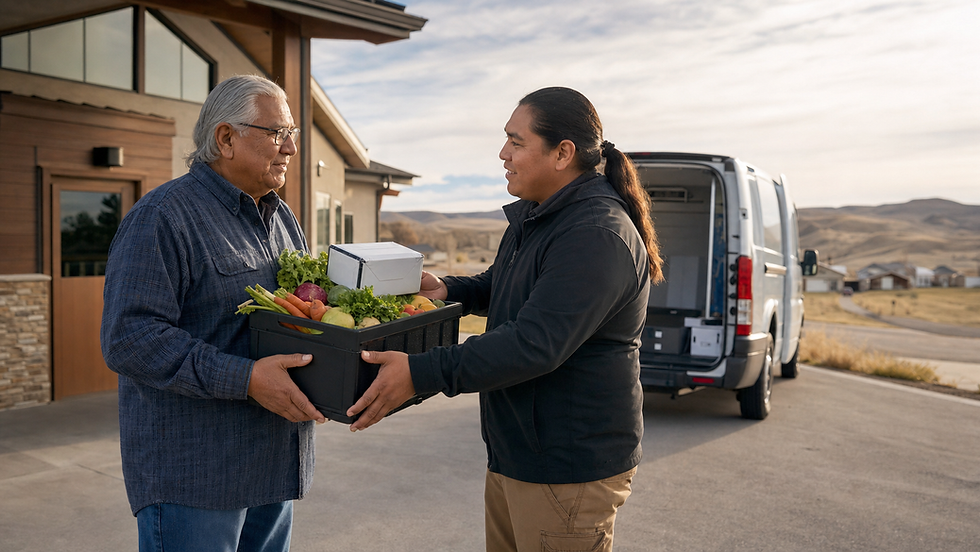
Growing fresh food is only the beginning. For that food to reach people reliably, production has to connect with the way food is handled, stored, moved, managed, and delivered to the places the community actually uses.
That does not mean every community needs the same equipment, facility, staffing model, or distribution plan. It means the full path from growing to access has to be understood as one connected system.
For Tribal leaders, health organizations, Native producers, and economic-development teams, the practical question is not only, “Can we grow it?” It is also, “What has to happen next so the investment works for our community?”

Growing Food Is One Part of a Larger System
The Indigenous Food and Agriculture Initiative describes a food system as an interconnected web of people and processes that supports both the growth and distribution of food for a community. That distinction matters.
A strong growing system can still face problems when the next handoff is unclear. Fresh food may need an appropriate place to go, people prepared to manage it, dependable movement between locations, and a realistic connection to community programs, buyers, or other destinations.
The lesson is simple: production cannot be planned in isolation from access.
The Most Important Gaps Often Appear Between the Pieces
Food-system challenges are not always caused by one large failure. They can appear in the spaces between otherwise good ideas.
Food may be grown successfully, but the available storage may not fit the timing or volume. A distribution partner may be ready, but the operating roles may still be unclear. A community destination may want fresh produce, but the handoff may not match its schedule or requirements.
Public supply-chain guidance from the Indigenous Food and Agriculture Initiative shows why distribution channels, production scale, food specifications, aggregation, transportation, and customer relationships must be considered together. Its reporting on warehouse disruptions in Indian Country also demonstrates how delays in storage and transportation can affect whether food reaches people as expected.
The goal is not to copy somebody else's model. The goal is to understand where the connections are strong, where they are vulnerable, and what kind of solution fits the community's priorities and realities.
A Community-Fit Solution Starts With the Right Diagnosis
Every Tribal community brings its own geography, leadership priorities, available facilities, workforce, partnerships, food traditions, destinations, and long-term goals. A solution that works in one place may be too large, too small, too complicated, or simply wrong for another.
That is why Aambe begins by helping leaders understand the problem they are actually trying to solve.
The public question may sound straightforward: How do we get more fresh food into the community? The work behind the answer requires a careful look at how production connects with daily operations and dependable access.
Aambe helps communities identify where that path may be breaking down, clarify what a successful outcome should make possible, and shape a solution around the community rather than forcing the community into a predetermined model.
The detailed analysis, system design, and implementation plan should be developed with the Nation and the right operational partners. Those decisions belong in a focused planning process, not in a universal internet checklist.
Technology Matters, but It Cannot Carry the Whole System
Aambe Living Food supports communities exploring year-round local food production. Growing technology can be an important part of that vision, but technology alone does not decide how food will move, who will operate the system, or how it will connect with the people and programs it is meant to serve.
The strongest plan connects the growing environment with the operating environment.
That connection is where a promising food project can become a dependable community resource.
What Aambe Can Help Leaders Do
Aambe can help Tribal leaders, health organizations, producers, and economic-development teams:
Diagnose where the path from production to community access may be getting stuck.
Clarify the desired outcome, practical constraints, and people who need to be involved.
Explore a right-sized solution that connects growing with operations and distribution.
Bring the right conversations together before major assumptions become expensive problems.
The result is not a generic template. It is a clearer path toward a solution designed around the community's goals.
Start With the Full Question
If your community is exploring year-round fresh food production, begin with more than the growing system.
Ask whether the full path from harvest to community access is ready to work.
Aambe can help you diagnose the gaps and explore a solution built around your community's priorities, operating realities, and long-term goals.
Quick Questions
Is indoor growing enough to create dependable fresh-food access?
Not by itself. Growing can be a valuable part of the solution, but dependable access also relies on the people, operations, storage, movement, and destinations surrounding it.
Does every community need the same food hub or distribution model?
No. The right approach depends on the community's goals, geography, operating capacity, facilities, partners, and intended destinations.
How can Aambe help without imposing a predetermined model?
Aambe can help leaders diagnose where the system is getting stuck, clarify what the solution needs to accomplish, and explore a right-sized path with the community and appropriate partners.

Comments