


Who Should Be at the Table Before a Tribal Health Decision Moves Forward?


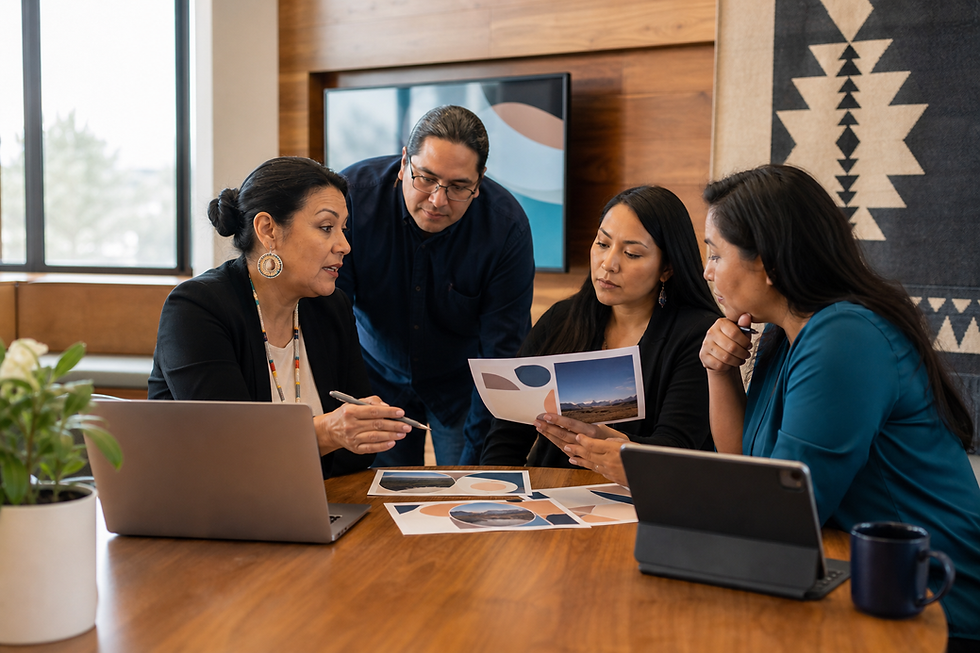
Representative image created with artificial intelligence. It does not depict a specific Nation or actual meeting.
A strong Tribal health decision begins with a question before the plan, vendor, budget, or timeline takes over:
Has the Nation decided whose authority, knowledge, experience, and responsibility should shape this work?
There is no universal participant list. Every Native Nation has its own government, health system, priorities, protocols, and way of making decisions. The Nation determines who belongs in the conversation and how that conversation should proceed.
The useful principle is simple. Bring the people who have the authority to decide, the people who will live with the outcome, the people who understand the care and community realities, and the people who will be responsible for making the decision work.
The Nation determines the process
Tribal health governance does not look the same everywhere.
The National Indian Health Board explains that health governance structures and scope vary among Tribes and that each Tribe has the right to govern its health system in ways that fit its community. Read the National Indian Health Board issue brief.
That means an outside organization should not arrive with a fixed committee list or assume that a familiar business process will fit every Nation. The first responsibility is to understand the Nation's goal and follow its direction about authority, participation, timing, and protocol.
This article offers a leadership perspective, not a universal governance model. It is not medical, legal, regulatory, or formal Tribal consultation advice.
Begin with the outcome, not the organization chart
When a health initiative begins with departments and job titles, the conversation can become about who owns which task.
A better starting point is the outcome the Nation is trying to create.
Is the priority better access to care? A more reliable patient experience? Stronger workforce stability? A new clinic or pharmacy? Better coordination between programs? Greater local control?
Once the desired outcome is clear, the Nation can identify the people whose authority and knowledge are necessary to shape it.
Include the authority to decide
Every project needs clarity about who can make the decision, who can advise it, and what approvals are required.
That authority may involve elected leadership, a health board, executive leadership, program directors, or another structure chosen by the Nation. An outside partner should never assume that the person who attends the first meeting has authority to approve the work.
Respecting decision authority protects the Nation's process and prevents a project from moving ahead on incomplete assumptions.
Include the people who understand the lived experience
Health decisions affect people beyond a conference room.
Patients, families, Elders, youth, community representatives, and frontline staff may understand barriers and strengths that are difficult to see in a proposal or data summary. The Nation should determine how those perspectives are invited, protected, and considered.
The National Indian Health Board has described its own strategic planning work as beginning with listening so that Tribal voices, lived experience, and community wisdom can shape direction before decisions are made. See the National Indian Health Board Listening Hub.
Participation should be meaningful. Asking for input after the solution is already settled is not the same as allowing people to influence the direction.
Include the people who understand care and community realities
Clinical leaders and health professionals contribute essential knowledge, but they are not the only people who understand how care reaches a community.
Community Health Representatives, program staff, care coordinators, patient support teams, and other Nation selected voices may see transportation, trust, communication, home, family, and service barriers that affect whether a plan works in practice.
Indian Health Service guidance describes Community Health Representatives as a broad community workforce that can support care coordination, health education, screenings, referrals, home visits, advocacy, and connections between patients and health or social services. Read the Indian Health Service Community Health Representative guidance.
The right mix will depend on the decision and the Nation.
Include the people responsible for making it work
A decision can be sound in principle and still struggle during implementation.
Operations, facilities, finance, technology, data, privacy, procurement, workforce, and communications may all affect whether a health initiative can be carried out responsibly. Not every function needs to lead every conversation, but the people who will carry the responsibility should have a meaningful opportunity to identify practical needs before commitments are made.
The Indian Health Service National Combined Councils meeting reflects the value of bringing different health disciplines and councils into shared discussions about patient outcomes, health disparities, quality, safety, and workforce capability. See the 2026 National Combined Councils meeting.
Partners should contribute without taking over
An outside partner may bring experience, technology, services, relationships, or implementation support. It should also bring humility about what it does not know.
The partner's role is to listen, explain its capabilities and limits honestly, and help the Nation shape a response around the Nation's priorities. It should not bypass leadership, dominate the room, manufacture urgency, or treat access to the community as a shortcut to a sale.
Formal Tribal consultation has a specific government context. The Indian Health Service describes consultation as an ongoing process of information exchange, respectful dialogue, mutual understanding, and informed decision making between Tribal Nations and the federal government. Ordinary business engagement should not borrow that term casually. Read the Indian Health Service Tribal Consultation Policy.
The strongest table is shaped by the Nation
The right people are not simply the largest group available. They are the people the Nation identifies as necessary to understand the goal, protect the decision, represent the people affected, and carry the work forward.
At Aambe, we believe community priorities should lead. Our responsibility is to arrive prepared, listen well, respect the Nation's authority and process, and help shape a useful response around what the Nation is trying to accomplish.
If a Nation has identified a health priority and wants a prepared partner to help shape the next step, Aambe welcomes a conversation.


Comments